

What Sanctuary Means
Hungry . . .
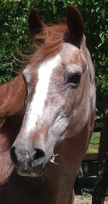
Sassy: looking good.
To many horses, Sanctuary means freedom from hunger, a serious danger to horses like Sassy, left with three other horses in the care of her deceased owner ’s elderly mother who suffers from early dementia. This aged mare and her companion Chance languished in a small pen with little food or water until a caring relative called for help. Intervention by law enforcement resulted in Sassy and Chance being surrendered and arrangements made for Equamore volunteers to transport them to the Sanctuary. Although both horses were undernourished, Chance’s youth allowed him to bounce back quickly. Sassy needed more time and special food to recover normal body weight. For several months, she rested her sore feet in a stall next to Chance, from time to time venturing out with him to the soft ground of the jumping arena.It will take even more recuperation before her feet are back to nearly normal, but as her photo shows, Sassy lives up to her name, retaining a kind eye and willing spirit.
Neglected . . .
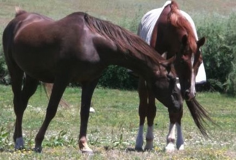
Finn and Hoover: making friends.
For other horses, Sanctuary means safety from owners who fail in their stewardship obligations. Such neglect often goes directly to a horse’s feet, as it did with Hoover, who came to Equamore Sanctuary unable to walk on his “slippered” hooves. Though Hoover received the best of care, he succumbed to his condition in July of 2012, for neglect of the feet can be irreversible. For his last seven months of life, Sanctuary meant that Hoover was able to walk to the fields, where he could satisfy the need for grazing and companionship that are hard-wired into a horse’s very nature. He will be missed by Thor, his constant companion, and Finn, his newest friend.
Abused . . .
For the most unfortunate horses, Sanctuary means an end to abuse. Recovery to physical health, even for a horse suffering from malnutrition or neglect, is easy compared to a recovery to mental health for horses who have suffered cruelty. Some of these animals endure in silence, their lifeless eyes looking inward as they protect themselves from owners who torture them daily. Others react overtly with fear or aggression, which makes such horses particularly dangerous to those who try to help them. Echo’s reaction, even to those who treated him gently, was to attack. Bader cowered if handlers got too close. Thor bolts with frightening speed, no matter what’s in the way of his escape. Time, patience, and skill are the only cures for these special horses.
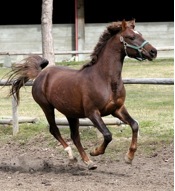
Running free!
Beyond their physical needs for food, water, and clean surroundings, horses need other horses to be healthy. To meet that need, Equamore horses are introduced as soon as possible into the Sanctuary’s mare and gelding fields even though horses are often rambunctious in their day-to-day contact with each other. On the day Bader joined the gelding band, the introduction ritual lasted an entire day. At the top of the field, it was as if everyone wanted to race the new Arab, judging their speed against his. Bader would take off with several horses behind him. The entire group of four to five horses would stop suddenly to spar with one another and then take off again at top speed. From afar, it looked both dangerous and violent, with periods of neck arching, squealing, and prancing interspersed with periods of peaceful grazing until it was time for all the horses to be taken into their stalls for the night.
Never Again!
The next morning, it was all settled: Bader had established his place in the herd. Imagine what that meant to the chestnut gelding, whose previous life as a stallion had been spent almost entirely in isolation in a ten-by-ten dog kennel, a constant agony for an animal built for speed and movement. When he was able to race freely in an open field and touch other horses, Bader’s healing was finally complete. Returning to his stall, without a mark on him despite a day of “catch me if you can,” the spirit had returned to his eyes and his step was animated. At nineteen, he had finally had an entire day of living as horses are meant to live.
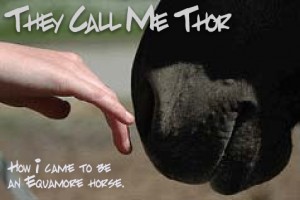
Click here to see Thor’s blog.
At Equamore Sanctuary, such miracles are the norm. Both Bader and Echo have had the years it takes to make the transition to healthy boundaries with their human handlers. Thor, having joined us a mere nine months ago, is still learning. You can watch his progress as it’s documented by his sponsor, whose care and generosity is making his recovery possible. “Call Me Thor” will be a regular feature of our new web site at www.equamore.org.