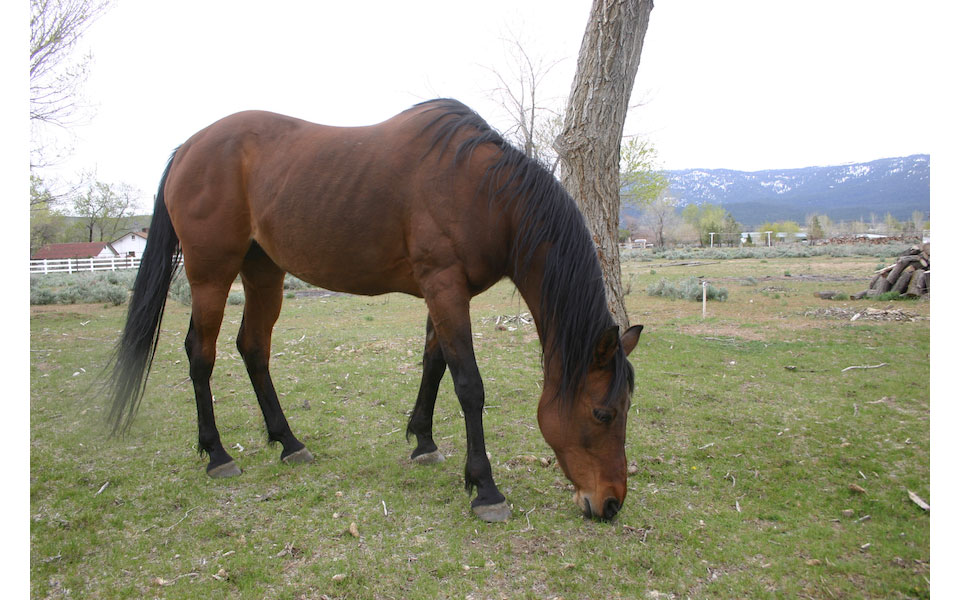


Someone once told me that Arabian horses make a decision about human beings: they decide whether they’ll allow us to be their “owners.” If you buy an Arab, a “bill of sale” without their hoof print on it is worthless as far as they’re concerned. My Arab was a holy mess when I bought her for $600 from her “owner.” I actually thought she was going to die and was saving her from a slaughter sale. There was something about her, as ill as she was, that said to me, “This is a spirit too fine to let go without a fight.” She had what the vet said was a cancer on her abdomen; she was skinny as a rail; her mouth was ulcerated from lack of dental care, making it painful to eat; and she actually smelled bad, which I thought was impossible for a horse. Her name was “Sarah.” I hate human names for horses so I added an extra “a” to her name, expecting that all I could do for “Sahara” was to give her a name to match her breeding and make her comfortable until the end.
I hadn’t counted on how tough this little horse is. The “cancer” on her stomach turned out to be an infected “summer sore,” a condition caused by flies laying larva in an open wound. The infection, deep into the flesh of her underbelly, was so bad that all Sahara could do, like Faulkner’s Dilsey, was “to endure.” The first day I owned her, I took a stiff-bristled brush to the wound, scrubbing until I could see healthy flesh. The mare continued to endure. To secure a medicated dressing to her belly I placed it under a surcingle which went around her entire barrel, sort of like a saddle upside down. She still endured, allowing me to get under her day after day and do what had to be done, no matter the pain. I scrubbed and changed the dressing three times a day for two months. Miraculously, the tough little horse did more than endure: she started to heal.
Still, Sahara did not flourish as she should have. I knew something else was wrong. She tripped on occasion, her back legs just didn’t work the way a horse’s legs are supposed to work, and her breath sometimes came in rasping gasps. Following the suggestion of a good friend whom I think actually is a horse in human form, I had her tested for EPM, a condition that causes nerves to die, enervating the muscle tissue, causing eventual paralysis, and, finally, death. As if her life had not been hard enough, the test came back positive. The only luck we had was the release of a new EPM medication the month after Sahara’s diagnosis. For three months, I bribed her with coca-soy oil and grain to take her new meds. Slowly, she appeared to be gaining on the microscopic protozoa whose unchecked reproduction within her nerves was causing her nerve cells literally to explode.
Despite the medicine and the gradual recovery from EPM, however, Sahara continued to stink and stayed stubbornly skinny. Worse: she was absent — I can’t think of another term for it except “absent.” When horses are in unbearable pain or have endured ill treatment for too long — not having suicide as an option, they just go somewhere else in their minds. For some horses, this absence of mind takes the form of weaving (rocking mindlessly back and forth); others “crib”; a few, like Sahara, just sort of submerge deep into themselves. When that happens, a horse’s eyes, normally so expressive, change. Sahara’s eyes were flat, dull, lifeless; she could see to survive, but she refused to look out of herself except for that purpose. And there were three distinct “worry lines” above each eye socket.
Dead nerves can be replaced by healthy nerves, which can grow beyond their normal length to connect to and stimulate enervated muscles. If nerve loss is recent, muscles can be rebuilt; but the process takes at least a year. I rode Sahara throughout that healing year. I ride “dressage,’ which is, simply, athletic training, a sort of gymnastics for horses. Slowly, Sahara’s awkwardness under saddle, a halting gait which made her forehand and hindquarters look as if they were going in different directions, was replaced with lightness and balance. Her jarring trot became a smooth “Western jog,” and her canter, always good, a rocking-chair glide around the arena. A rigorous regimen of equine dentistry, chiropractic manipulation, and acupuncture every three months completed the physical transformation. Sahara was gorgeous, with the spirit of her ancestors shining in her deep bay coat. But that spirit was still absent from her eyes. It takes longer for eyes than it does for muscles and skin and hair.
It was during our second year together that the change I longed for in my diminutive bay mare was finally complete. It showed itself in subtle ways: sometimes there was one less worry line above each eye, sometimes she was curious, and often she had a good, clean-horse smell. It was as if she were saying, “OK, I’ll come out, but please don’t hurt me. I’ll do anything you ask as long as you just don’t hurt me.” We still weren’t out of the woods by a long shot: if something bad happened — she got kicked by another horse or tripped or, worst of all, was victimized by some unthinking carelessness on my part — she would disappear inwardly again, her eyes a deathly dull, the worry lines written again in triplicate. Gradually, as I learned better to understand her need not to be rushed, to be coaxed gently back into this world, those absences grew shorter and less frequent. I knew we’d turned the corner when one day she pulled back against her tie rope in response to some dumb thing I had done and flipped herself over onto her back while saddled. She struggled to her feet, trotted a few strides away, and stood stock still, looking at me. She was not going away this time her look said; instead she was waiting for me, not to fix things but to be with her while she recovered herself. I walked to her and cradled her head in my arms, which I could not have done had she not arched and lowered her neck to receive my touch. For several minutes, we soothed one another, she forgiving my carelessness, I forgiving her panic. Sahara, no longer Sarah, had been re-born. (To be continued)
The second part of this story will appear here next week